Editing, Leadership and Team Building
_edited.png)

Photo by Sara-Beth Badalamente
To me, “editor-in-chief” and “middle school adviser” mean a lot more than just making changes to stories and doing what I can to produce high-quality content. These words mean spending time with each member of our staff to make them feel included and taking the time to learn about people beyond the newsroom. They mean pushing people beyond their comfort zones while also knowing where to draw the line. They mean resolving conflicts and making sure everyone’s needs are met. I see the power of becoming not a staff but a family that is there for each other, day and night.
_edited.png)
EDITING
Planning stories
A major part of my role happens before stories are ready. Our story pitch routine is always pretty extensive – we start with a brainstorm, then a Google form and finally go back and forth a few times to establish the set plan for stories.
The brainstorm, especially, is something I am very particular about. I really try to have us do group brainstorms around the classroom as much as possible at the start of each cycle. We have these big poster papers in the room that we'll lay out for people to write their ideas for each section. This helps a lot because people who have a lot of ideas are able to then pass them on to others who need some help, and the work gets evenly distributed among the staff.


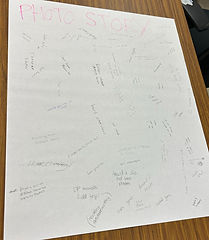

These are just a few of the posters we'll put out. I'll often get these ready during seventh hour the day before we do the brainstorm so it is ready to go. Everyone will get into groups, our adviser will set a timer and then we rotate throughout. People will write their names next to the stories they want to write. Photos by Satvika Ramanathan
Then, after this, I begin reaching out for clarification on stories and to flesh out. Most of the time, this is a conversation, but sometimes it's an email if I am not able to talk to the writer in person.

This was for a story that we wanted to put in print. I wanted to make sure he was covering his bases with sources, and we went back and forth a few times on who else he was reaching out to and should reach out to, including staff, administration and the IT department.
If writers need further assistance with settling on topics, then I also sometimes help them with brainstorming things like researching people to reach out to, drafting emails and brainstorming interview questions.
Before I edit
At the beginning of this year, I brought on a copy editor, Lakshya Jaiganesh, as we didn't have a copy editor when we resumed publishing in the fall. I felt it was vital to have someone able to go through for grammar, AP style rules and structure before the editors-in-chief and section editors come in for stylistic choices.

This was a slide I made to show in class as an announcement that Lakshya was now our copy editor. I encouraged her to fill out an editor application specifically to become a copy editor, and our adviser was happy to add her to the team.
I also make sure that there are enough eyes on the story before I go in to begin editing. We have a large team of editors and editors-in-chief, and often, I am the last person to look at a story before it is published. When creating deadlines for print, I make sure to lay out deadlines for section and copy editors to do their editing and then deadlines for me and other EICs to do our editing.

This is an email I sent out enforcing this before our second issue of the year.
Editing Stories
My editing process for stories varies depending on the type of story, where it is going to be published and who is writing it.
Because we have three sections of newspaper, it is not always possible for me to sit down face-to-face with writers and go through their work. I try my best to establish connections utilizing free hours and lunch, but realistically, a lot of the editing that I do for people who are not in my hour of newspaper ends up being online through email, Google Docs comments and text.
I am also one of three print editors-in-chief, and we have a team of ten editors-in-chief across print, web, social media and our new sports website. This means a lot of content doesn't run by all of us, but I do try to make it a priority to look over as many stories as I can, even if they are not going in print.
There are a few things that I am looking for when editing stories, and I try to go from out to in – so starting with the big picture of the story and slowly zooming in to the details to create a good final draft.
_edited.png)
The first thing I ensure I check is if the story fits the requirements for its section. If it's a news or a feature story, it should avoid opinion or any editorializing. If it's an opinion article, it should include its call to action at the very beginning of the story. Even though this seems like it may be blatantly obvious, because of that, these things sometimes slip through the cracks, and I find that I often will go through and check for these clear requirements.

I left this comment on a story about University of Michigan Health’s decision to ban gender affirming care for youth. The writer had included an opinionated portion, and I wanted to make sure they either quoted someone saying that or removed their own feelings.
Next, I make sure the structure of the story is solid and easy to follow.

Here, a story featuring multiple people's ideas on a topic was broken into sections but didn't have subheads to clearly separate the story out. I suggested that the writer add subheads to make it visibly divided for ease. I also suggested some options for the writer of the story to showcase the content of the section.

I then look at wording. I try to make sure our stories are as efficient and effective as possible. Sometimes this means suggesting alternative lede ideas or just going through and suggesting small changes to ensure the article flows smoothly.

For instance, this story was written by one of our editors about how teachers wear blue every Wednesday as a form of unionizing and banding together. Eleven years ago, the senior teachers' salary was cut three percent, and that was the stat that the writer wanted to start with. It was a beautifully written article, but the lede was formatted in a way that I felt didn't portray that it was actually important. Although three percent is a lot to be cut from a salary, without the context, it seems over dramatized – just starting with "three percent" doesn't have the same effect as stating what that three percent was. So I suggested an alternate lede, and the writer agreed and edited the story.

Finally, I'll examine the little details of the story and go through for small tweaks that might contribute to the overall message of the story.


This was a specific question that one of our writers asked me about how to quote an anonymous source from a No Kings protest that she was reporting on. In these situations, I make sure to take the context of the story into account when making suggestions. Here, I didn't feel it was necessary to assign the name of Jane Doe to this person as she wasn't quoted anymore throughout.


This was a different type of zooming in to the details – our front page story for the first issue last year was an opinion piece about Charli XCX's "brat" and its overlap between politics and pop-culture. Although it was odd to start the story lowercase, I thought we should stay consistent with the album's stylistic choice and be consistently lowercase with "brat" throughout the story.
At the very end, I make sure to check back and include a final note and some positive feedback in order to encourage our staff members. I find that as I edit more and more stories, this is something I have to consciously prioritize, as when you are going through bulk, for time's sake, it's not always easiest to point out what the writer did well, but this is something that is extremely valuable for positive feelings between the staff and the editors. I also like to often sum up my thoughts into a final message to help the writers focus in on the important points to tweak in their stories.


A few examples of positive comments that I sprinkle throughout.

This is one "final" comment I left on a personal narrative that I edited.
Fact checking
Fact checking is becoming increasingly important in our newsroom as the big topics that are affecting students are getting more serious. Our goal as a publication is always to report the truth correctly and with integrity, as outlined in our mission statement.

The mission statement of The Huron Emery, as written on our website.
This often means sitting down and ensuring that everything we as a staff are reporting on is accurate.
At the beginning of January, there was an incident in a neighborhood where many Huron students live in which a man barricaded himself inside his house. The police blocked the roads off, and students in that neighborhood were unable to attend school that day. One of our staff writers, Annika Richards, wanted to cover the story, so she observed and took detailed notes as updates were occurring. She wrote the story, but before she published it, we wanted to make sure that each fact she said had a source tied to it.
My adviser, co-EIC and I sat with her and looked for news articles and outside sources to back up everything she stated in the quote. We tried to make anything that she observed herself or heard from another person clear on the source.


This took a while. I came in during my 20-minute lunch period to work with Annika, and after lunch and her class ended, I stayed with my adviser for another 30 minutes at least to scour the internet and triple check wordings and sources.
We wanted to guarantee that we were reporting exactly as the events proceeded without editorializing.
The final article was published here. It jumped up to our top trending story on our website for the following weeks.
These are comments I made for Annika as we were sitting together so she could find where she got info as I looked elsewhere.
Design Feedback
Last year, I found that our design feedback was often going out too late to be as effective as we would have hoped to our designers. My then-co-EIC and I developed a schedule for each design cycle where we would leave a little extra time between sketches being due and final designs due in InDesign so that the two of us could sit down and give proper individual feedback for each page before anything started being placed. This year, my co-EICs Anjali Nadarajah and Ella Yip have also been helping me carry this forward. I've found that this has been exponentially helpful in terms of taking the workload off at the end of the cycle during our last copy edits.
We usually do this by making a slideshow in Canva, with each slide corresponding to each page. We then share it with the group before class, and will talk individually to everyone to clarify any doubts or confusion about our comments.
This was one of the first times we tried this method out. Some comments are written in purple on the Canva slideshow, and some we wrote directly on the papers in black pen before taking a picture and uploading it.
I've also been trying to hone in more on leveling-up our designs. Below is a photo of me showing the team possible design options and using design elements to add visual interest to our pages. Every once in a while, I'll notice our designs tend to start looking relatively similar, so during this times, it's often helpful to see examples of how to switch things up.

Photo courtesy of Sara-Beth Badalamente
Stay late days
We usually do a stay late day the week before we send our issue to press. The purpose of these are to mostly finish out pages while also having some aspects of team-bonding involved. Although most of the design work for our newspaper is done outside of these days, there is something about sitting as a group and working towards the common goal of printing that serves as a good reminder of why we do what we do – I've found it is helpful for motivation of our designers and editors.

Pizza during a stay late day! Photo by Sara-Beth Badalamente
During this time, one of the other print EICs or I will also make a to-do list for us so that we know what specifically needs to be finished out on each page.


This was a final to-do list I made for issue 5 in the spring. Sometimes, like in this case, there are many things to be finished on each page, in which case we just assign out pages and tackle it. Other times, it's smaller nitpicky things, and that usually gets handled straight from copy editing.
One of the highlights of our stay late days are crossing off pages on the whiteboard as they are finished.

This was a time-stamped schedule we had made to finish out pages (during class, actually, not a stay late day) – after we sent to press, I excitedly crossed out "dance party."
Copy editing pages
The last step before we send to press is always copy editing the pages, re-exporting and doing this over and over until we feel everything is ready. I usually do this in multiple rounds, both at school and in the evenings at home before we send.
Whenever I am physically in the newsroom copy editing, I always make it a priority to copy edit pages on paper and then transfer the edits into InDesign. Seeing the whole page printed in front of me makes it much easier for me to catch errors and understand how the pages will look visually as a set.

This is a photo of me editing the middle school newspaper,The Cougar Star's issue 2 pages this year. Photo courtesy of Sara-Beth Badalamente
I also usually end up going through two or three rounds of copy edits on Google Drive, as that is an easy way to make comments and then go straight from there to fix and re-export in InDesign. Once we are fully through with copy edits, we send the Google Drive folder to our printer, and the paper is finished.
This is a screenshot of a final Google Drive folder with our exports after we finished copy editing. I am usually the last person to take a final look at and export pages to send.
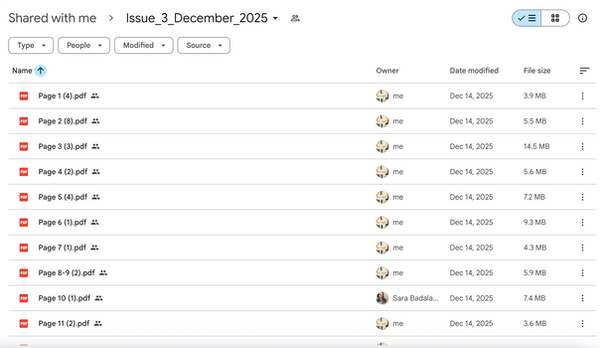
The tricky thing with copy editing is that it is never-ending. I could look at a page five times and still catch something new that I missed on each look. We try our hardest to get as many eyes on a page as possible, and even so, there are still things we inevitably will find after we receive our newspaper in the mail. I know that this is just a part of the process, though, so as much as I focus on all the nitty gritty details to try to perfect each section of every page, once it is sent, I let it go and try not to worry too hard about what I might have missed.
ADVISING
My journalism journey started when I was in sixth grade in 2019, and I joined the newspaper club at Clague Middle School, The Cougar Star. I was able to help restart the newspaper program after it had been dormant for a few years, and I was the person who initially set up the website. I discovered my love for writing features and breaking news pieces, and, especially during online school, I spent all my free time writing, editing and posting articles.
For all four years of high school, I've been going back and helping out with the club. I am now a co-adviser of The Cougar Star along with my own adviser. It's been so wonderful to be able to give back to such a staple part of my middle school, and I love being able to help other students find a joy for journalism in them that I found in myself.
Advising
As an adviser for The Cougar Star, my tasks span a large array of items throughout the year: from helping choose editors to leading initial lessons on the basics of journalism to coming up with plans and helping run meetings.

After finding last year that there were so many middle schoolers and it was difficult for us to remember everyone's names, I suggested that we bring a round-up to the middle school level for the first few weeks to get to know each other better. Photo by Satvika Ramanathan

I lead brainstorm sessions, especially before print issues, to help the middle schoolers share and come up with ideas. The kids will usually sit around the whiteboard and I'll either write their ideas up there or have them come up and write it themselves. Photo by Satvika Ramanathan
This was a presentation I made with my adviser specifically for the middle schoolers. We have lots of these types of slideshows and activities for them to do during the first couple of months.


They were also named Pacemaker finalists for print last spring for the newspaper that they began printing last year as well as for web this year.
Editing
Me editing as an EIC for The Emery is very different from me editing as an adviser for The Cougar Star. I always make sure to keep in mind what is important at the middle school level when I am looking through their stories.

My comments tend to be more focused on structure and grammar over anything else. My goal is to help them understand the fundamentals of journalistic writing and AP style so that they can bring these skills to the high school level and beyond.

I made this spreadsheet that we can use to keep track of stories that are being sent to us and any notes we have.
Leading Rotations
Because there are so many middle schoolers on The Cougar Star staff, it is often easy for us to do rotations and divide them into groups. We are lucky because there are usually a few other high schoolers who also come and help out, so we can each take a group and teach them how to create content for a specific section.
Some examples of rotations that I've run in the past include Instagram, podcasting, digital media, photography and news writing.

Photo by Sara-Beth Badalamente
LEADERSHIP
Communication
Communication really is key in the newsroom. Even with the three sections, I really try to make it a point to know as many of the staff members as possible across the day and check in as much as I can.
The three hours of newspaper we have are fourth hour, sixth hour and seventh hour. I am extremely lucky because although I am only enrolled in sixth hour, I have lunch during half of the fourth hour class and have an online seventh hour. This allows me to come up to the newsroom whenever I need during newspaper.
Especially at the beginning of the year, I made sure to come in and get to know staff members from the get-go so that people are able to reach out.
From the standpoint of the editors, I've also been flexible over the past three years with finding the best form of communicating and using group chats. During that time, I have switched from GroupMe to Slack to Google Chat. Each year, with a new team, there are different ways that they find it easy to communicate, and I make sure to meet everyone where they are at to find the best way for us to stay in contact. This year, we've settled on Google Chat as it is automatically accessible through everyone's emails.

We used GroupMe last year, and although it was great for sending out mass communication, it was pretty one-way. This year, I decided to move away from this to try to encourage more people to feel comfortable sharing.

This was the Slack channel I created at the beginning of the year. Some staff members had a difficult time joining, so although we still use it a little bit to communicate to the whole group, we shifted away from it for communication between editors.

This is the Google Chat group that we now communicate daily in. Everyone has been great about pitching in and responding.
In addition to this, we, of course, are very active on email. I send out reminders, deadlines and information out weekly to various groups including editors, designers and staff members.

At the beginning of each design cycle, the print EICs send an email out to everyone with an assignment relating to the print edition to be clear on deadlines and what the issue will look like.
Google Sheets
Google Sheets has really become my best friend. It really is the most accessible way to keep track of all the constantly moving parts of our newsroom.
One of the big things that I use it for is to lay out our plan for each issue of the newspaper. My co-print EICs and I will sit down after we receive all story pitches for the design cycle (which we also store in a Google Sheet) and then choose what we want to go onto each page and who we want to design each page.

This was the distribution we had made for issue 3 of this year. We make sure to have everyone link their stories here, so this is the location to have everything related to the edition in one place.
We also use Google Sheets as a "turn-in" location for everyone's stories. This allows our adviser to be able to grade conveniently, but it also helps so that all editors can go through and edit whatever is under their responsibility without having to worry about digging through their emails for things.

This is the spreadsheet I made for story submissions during our issue 2 design cycle this year. Not everything submitted goes in print, but we follow design cycles for everything just for convenience. The web team assigns stories out as necessary and also pulls these stories depending on their needs throughout the design cycle.
Editors Meetings
Editors meetings are super helpful for us because we aren't often all in the same room at once. We typically do these at least once a quarter, but it can increase to monthly depending on how things are going in the newsroom.
When I call editors meetings, I make sure to first send out a when2meet poll to ensure that the majority of our team is able to make it.


I sent this when2meet out to coordinate a January editors meeting at the beginning of our issue 4 cycle. Most people were free Jan. 11 at 5 p.m., so I scheduled the meeting for that day and booked a room at a local library.
Usually in these meetings, I like to follow a structure where we start with some type of icebreakers and catching up, then go into any quick communications anyone wants to share and finally go into the bigger expectations and messages that we are hoping to convey.


Click on the screenshot to view a copy of the agenda I made in January. Throughout the meeting, we link items and make separate tabs with to-do lists, brainstorms, etc. as a resource for the group.
Photo by Sara-Beth Badalamente
Editors meetings can also be a good way for us to get support from the community. When they are scheduled outside of school time, we often will try to meet at local coffee shops or businesses that have bought ads from us, and it establishes a good two-way relationship with them. There is a real community feel that comes from all going together and buying drinks from a neighborhood cafe and then sitting down for an hour and chatting through the works of our newsroom.


We had a January editors meeting at a branch of the Ann Arbor District Library, and this is a copy of the full-page ad they bought for our February issue. Photo by Sara-Beth Badalamente


Last year, we had an editors meeting at Moonwinks and I filmed a group review there. These are a few ads that they've bought from us. Click on the screenshot of the Reel to watch it.
Calendar
We always make sure that a daily schedule is available to everyone to see what the plan for class is for the forseeable future. This is always laid out in an online calendar that is linked into the Schoology page for our class.

This is a small screenshot of the calendar. I add most of the deadlines and important dates regarding print to this.
Even with this online calendar, though, we are always getting questions about the plan for the class. Because of this, I also began copying the highlights from this onto a large physical calendar in the classroom, that I usually have ready a month in advance. This is up on the wall of the room for everyone to see. It serves as a useful tool, but it also is a nice decoration feature and it contributes to the newsroom-feeling of the classroom.

This is our February calendar that I made with our chief content editor Grace Henley. I've learned that with the paper calendars, less is more and I have to write big in order for everything to be visible across the room. Photo by Satvika Ramanathan
Staff Manual
Another classroom tool that I make sure to consistently update is our Staff Manual. This document is available to everyone, and along with expectations, policies and a style guide, it also contains any helpful tutorials, work examples or ideas that future leaders of The Emery may benefit from.
I make it a point to update this with any information my adviser wants me to share with people so that it can be used as a reference point for all sorts of FAQs that people may have.

I added this "how to" section at the bottom of the Staff Manual with links to videos I've made with tutorials for these things.
Below are a couple of tutorials that I screen recorded.
Mini lessons
Teaching mini lessons is really important to me. I find that it helps with connecting with staff, and is also vital to getting a unified vision for the content we produce as a team. The mini lessons that I've taught over the past years have ranged a wide variety of topics, from interviewing basics to feature writing to the importance of diversity in the newsroom and everything in between.
My philosophy with teaching mini lessons is always to present the information in a way that is as digestible as possible while also getting to the heart of the task. It's not just how to go through the basic motions of an interview, but it's also why interviewing is important and the mindset necessary for conducting interviews.
I also always like to include as many interactive elements as possible in my lessons – this could be videos, turn-and-talks, some creative task or anything else. Making sure my audience is engaged is always important to me.

Me teaching a feature writing lesson during my sophomore year. Photo by Sara-Beth Badalamente.
Difficult situations
As editor-in-chief, when there are challenges that the school faces, I have to communicate with the staff and manage decisions taken.
Earlier this year, a student at our school passed away. I sent a message out to the team regarding our coverage of the situation.

After sending this message out, I continued to have conversations individually and as a group with staff members. We ultimately didn't end up covering the situation, but it was an important discussion that we had to have.
Feedback
Getting feedback on how things are going is really important to growth of our publication. This can be both internal and external.
Within the group, I get feedback both through sending forms out and also just having conversations. We'll also often set time during editors meetings to discuss how things are going.
I made this Work Style form in my sophomore year to both get feedback from staff on how design cycles had been going. This helped us to make actual change to improve the efficiency of the newsroom – we could see what people's strengths were and were able to assign them tasks accordingly. There were also some people who indicated that they felt they needed more support, which then helped us as leaders in the room to be able to respond to that.
Although most of the forms I send out aren't this elaborate, I do make sure to do check-ins with enough frequency to identify challenges, patterns and potential changes to make for the betterment of the team.
Externally, I also try to get feedback from other peers, advisers and journalism people to keep finding ways to improve. A lot of this happens naturally at conventions and summer programs, but I also seek it out in other settings.
This year, for example, I asked my adviser to set a critique up with Jim Streisel, who does critiques for a small fee, to point out areas that we could be making changes.
He looked at both our print paper and our website and spent time going through a few things that we could be working on. His main piece of feedback was to incorporate more types of storytelling – not just text.
In print, we've been trying to do that more with having pull quotes, stat boxes and graphics with purpose to also help convey the big ideas.
And although I am not a web EIC, in my own web content I now always make sure that I am telling the story through multiple avenues.

We met via Google Meets for around an hour. We had print and web EICs, our design editor and our managing editor at the meeting.
Presenting at Conventions
I've been lucky to present at five national high school journalism conventions – both JEA/NSPA and CSPA. I've presented with other people as well as on my own, and I've done almost 10 presentations combined throughout these conventions, including the Art of Interviewing, Covering your School Board for Student Press and Diversity in the Newsroom.


A few photos from presentations I've done over the years in Boston, New York (twice!), Nashville and Seattle. Photos by Sara-Beth Badalamente and Vidya Ramanathan
Not only have I loved sharing what I've learned and improving my public speaking skills, these presentations have allowed me to connect with my peers, reflect on what I truly value about each of these topics and brought me closer to my own love for journalism.
Press Pass NYC
After I presented the Art of Interviewing at the CSPA convention in March 2024, California high school journalism adviser Erin Schneider reached out to me on behalf of a fellowship she runs to train other journalism advisers. This program is called Press Pass NYC for educators in the city of New York, and she asked me to do a zoom session where I gave this presentation but also focused on how teachers can apply this when teaching their students about interviewing.
I presented that fall to her group on Zoom and then again this past fall to a new set of teachers. It was so exciting for me to get to share these ideas to a group of people training other young journalists.


Screenshots of my first presentation in 2024 with New York City Council Member Rita Joseph in the audience for part of it as well. She addressed the group following my presentation.
These were the slides I used to present this year. I used the slides as a support mostly to showcase how I would present these ideas to staff writers.
Summer Training
A big part of growing as a leader for me is also seeking out outside opportunities to interact with professionals as well as peers from around the country. I've found a great way to do that is by going to a variety of journalism camps.
In summer 2023, I attended the Michigan Interscholastic Press Association's Summer Journalism Workshop, where I took a course on InDesign basics with Cammie Hall. That was extremely helpful for me, as that fall, I began as print editor-in-chief for my publication. This allowed me to develop design creation and editing skills that I have applied ever since.

Me (middle) with current Huron yearbook editor-in-chief Brody Turner and former Emery print editor-in-chief Anna Esper during the InDesign class. We are pictured working on our designs. Photo courtesy of Esper
The following summer, I took an Intro to Investigative Reporting class at the School of the New York Times with Pulitzer Prize winning journalist Brian Rosenthal. My evaluation from this course is linked here. There, I worked on a story pitch with a group focused on construction workers' conditions in the strong summer heat that year. After finding that our online research wasn't as helpful as we would have hoped, my group also walked outside and spoke with construction workers on the job about their conditions and thoughts.

Me with lead instructor Brian Rosenthal and instructor Theresa O'Neill Walsh on the last day of the program. Photo courtesy of Luna Lee Machida
Then, in June-July 2025, I spent a month at the Medill-Northwestern Journalism Institute (also known as Cherubs), where I went through a comprehensive series of lessons and activities encompassing all aspects of journalism with a team of experts from throughout the field. My assigned instructor there was Joe Grimm, professor at MSU and former editor at the Detroit Free Press. I also got to interact very personally with the whole team of adults during the month.

I loved the immersive, hands-on nature of this program. Because it was a month long, I really felt like I was able to develop my skills in each arena that we focused on. Photo by Irene Park
The day after Cherubs ended, I then flew out to Seattle for the Asian American Journalists Association's high school journalism camp, JCamp. I had actually been accepted the previous year and planned to attend, but I had to cancel last-minute due to health reasons. They were kind enough to let me attend this year instead. At JCamp, because it was a smaller cohort, I got lots of individual feedback and advice from our group of mentors as well as the plethora of guest speakers they had invited during the short one-week program.

Throughout the week, we went on multiple outings including a reporting trip and to broadcast and print newsrooms, and we were able to hear from a variety of experts in the field. We also attended a day of AAJA's annual conference, which was an amazing opportunity for meeting professionals and learning about what it looks like to go into journalism. Photo courtesy of JCamp
Seeking advice
One of my biggest points as a leader is to keep seeking advice. Whenever I am even slightly unsure about something, I always make it a point to reach out and ask someone for their thoughts – that person could be a co-EIC, my adviser or a mentor. I think this effort is really important for me to keep growing as a person. It then allows me to then give better advice to others.
Available and accessible
Similarly, I always make it clear that I am always able to help with things. I really try my hardest to get to know staff members in whatever capacity I can so that they feel comfortable reaching out and asking for support when they need it. This often looks like walking around the room and asking people how things are going. Sometimes, though, it's just sitting up at the front of the room and letting people know I am available, or putting my email up on the board for team members to send stuff to me. I try to be another resource for people to give our adviser a break from constant questions.

I try to be prompt with responding to emails from staff members.
From the team
Below are some quotes from staff members of The Emery.
"Satvika has been a great leader for us. When I was in my first year of newspaper she was very approachable. She helped me feel more welcomed and taught me a lot about journalism. She’s been very open to new ideas and she does her best to teach us and get us more involved." - Justin Phelps, Staff Writer
"Satvika is great at leading by example; she's the first person I look to for direction and writing advice." - Ava Bryan, Staff Writer
“She’s just the best. She is the most hardworking person I know and the effort she puts into everything she does inspires me everyday.” - Anjali Nadarajah, Print EIC
"Knowing and working with Satvika over the last six years has been an honest pleasure. She is consistently the most dependable person in a room at any given time and is truly passionate about what she does. She has inspired me to be a better journalist over the years, and I am certain she will do great things." - Isha Savi, Web EIC
"'Just make sure to ask Satvika.' This is likely our newspaper’s most common phrase, and I think it summarizes Satvika in one sentence. Not only is she an amazing journalist who continues to encourage those around her, but she is one of the most reliable people I’ve ever met. I can always trust upon her to help with anything, from page designs to last minute story edits. She isn’t just an inspiration in the newsroom. She’s the heart of it." - Salem Dinh, Social Media EIC
TEAM BUILDING
Names
It is really important to me to get to know the names of everyone in the room as early as possible during the school year. Every day, we do a "river rat round-up" where we all get in a circle and answer an icebreaker questions – I started implementing this a few years ago as a way for everyone to get to know each other on a more personal level. I would come up with questions for weeks at a time and constantly have a running list going. Now, the questions are written by our managing editor.
At the beginning of the year, though, for a few months, we'll have everyone say their name before they answer the question. This makes it really easy to learn names quickly – and I make a conscious effort to learn names ASAP.

This is an example of a river rat round-up in the slides.
Pub Olympics/Fun Day Friday

We always try to make sure that there are "team-bonding" days scheduled in whenever possible. At the beginning of the year, this is very structured with a "publications Olympics" that we help our adviser coordinate, featuring a variety of games that are totally unrelated to journalism to start to get people familiar with each other.
Throughout the year, too, we try to keep this going with occasional "Fun Day Fridays" where we play card games, craft and just chill together. We always make sure that these are no-phone times so it stays true to the essence of team-bonding.
One activity we love to do is put together cut up pieces of a cereal box and create our own puzzles. Photo by Sara-Beth Badalamente
Mentor/Mentee Groups
Another strategy that I help implement is mentor/mentee groups. We assign everyone in each hour to a group with one editor or returner to the class who is the point person for the rest of the group for anything to do with newspaper. They are able to ask specific questions about whatever work they are doing to this person, and it helps with making sure everyone knows how to get help. We also do group work with our mentor/mentee groups sometimes throughout the year.

I helped assign sixth hour mentor/mentee groups.
Bonding Events

We also try to do bonding events for editors every quarter or so, which I help our managing editor coordinate. This is really necessary for inculcating a team mindset as not all of us are interacting on a daily basis. We try to make them seasonally relevant, as well, which is really fun.
Our December bonding event was a Secret Santa gift exchange, so we all met up to drink hot cocoa and swap gifts, a fun start to the holiday season. We used the website DrawNames to coordinate.
Guest Speakers
I've found that having guest speakers come in gets me extremely enthused about continuing journalism, and I hope that it makes others feel similarly as well. We usually have one or two guest speakers come in every year.
This year, I wanted to prioritize getting a guest speaker to come into the classroom. At the top of my list were the editors-in-chief of The Michigan Daily, University of Michigan's student-run newspaper that many of our staff members follow. My sophomore year, the then-EIC of The Daily was a graduate of The Emery, so she had given a presentation to our class then, and I was so excited to hear about all the amazing things happening with journalism in university.
I thought that having a similar presentation this year would be a great opportunity for our whole group to see what continuing journalism at the next level would look like. I reached out via the email I found online, and Mary Corey, one of the co-EICs kindly responded and said she would be happy to come in for a presentation.
She talked to all three sections of newspaper with a short slideshow and a Q&A after.


Co-EIC of The Michigan Daily Mary Corey spent an afternoon with us at The Emery to introduce college journalism to us. Photo by Satvika Ramanathan
End of Year Banquet
We also often do a combined publications banquet (for both the middle schoolers and the high schoolers) at the end of the year to present awards, do paper plate awards and also celebrate the great work from the year.
I help organize and coordinate for this, especially on the newspaper side of things for both levels.
This is beneficial for boosting the team spirit of the staff.
I helped make this slideshow for last year's banquet. We went through the accomplishments of the year chronologically for all four publications.

I also presented awards during that banquet. Photo courtesy of Sara-Beth Badalamente
Encouragement of the team!
I always try to make sure to say thank you after people have done things really well or after the team accomplishes something big. This helps boost team spirit and keep motivation up to keep going and putting their best effort in. It also is good for me to keep being grateful!

I sent this email out to issue 3 designers after we sent the issue to press as I wanted to thank them for being flexible and stepping out of their comfort zones with their designs.
I also like to do shout outs during editors meetings to highlight a few editors who have really gone above and beyond for the newspaper environment. This can be in terms of workload for print issues, extra help or support for peers in the classroom or any specific example that stood out.